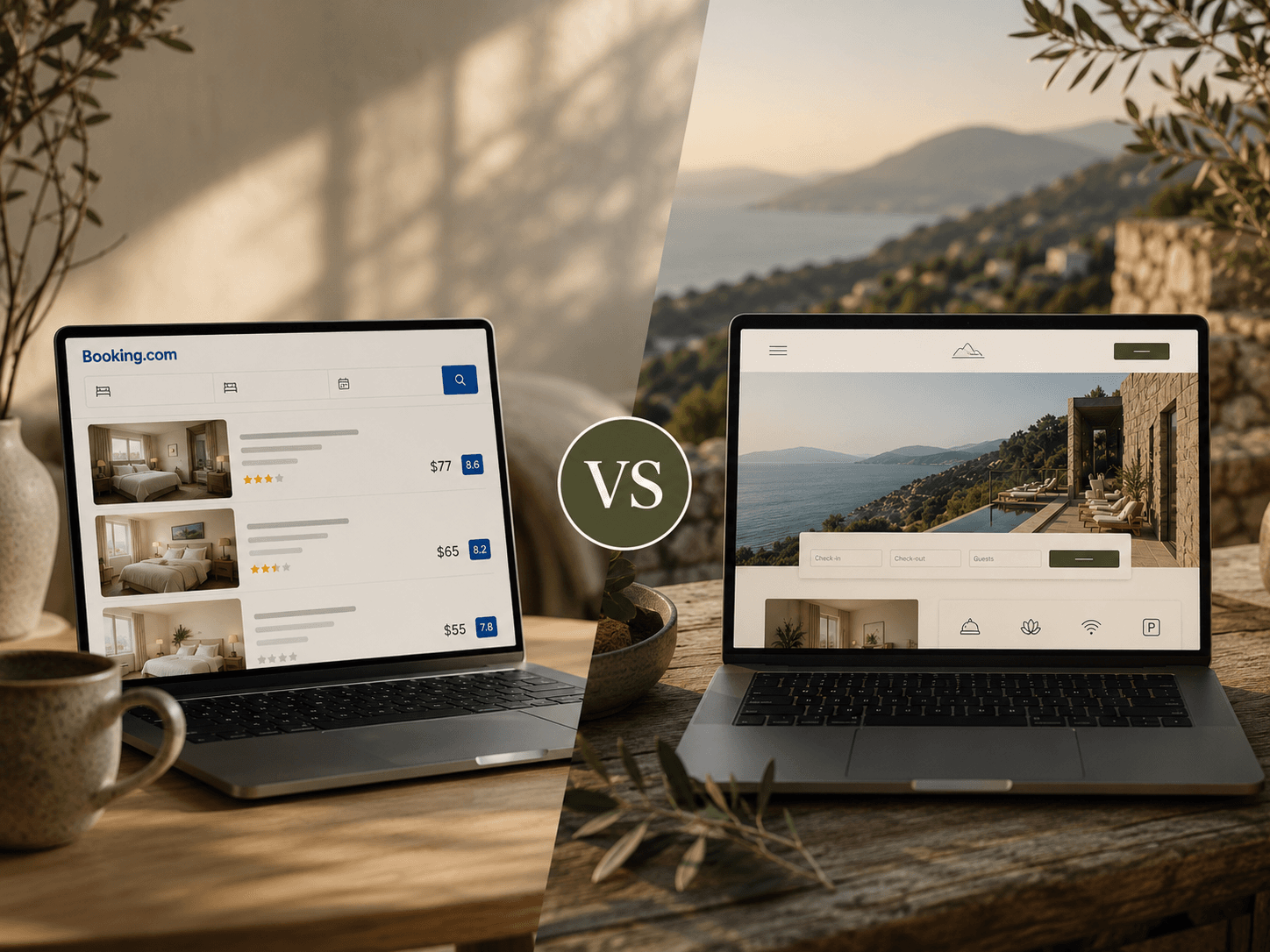
Picture this. You own a small, cozy hotel in Bakuriani. A guest is planning a getaway, opens Booking.com, sees your room, and books one night for 300 GEL. Three days later they arrive, enjoy their stay, leave happy. The money reaches your account. But instead of the full amount, only 255 GEL stays with you. The other 45 GEL goes to Booking.com.
Now multiply that one booking by 50 a month. By 600 a year. Soon you realize you are giving away thousands, sometimes tens of thousands, in commission every single year.
The question is simple: can you keep that money in your own pocket? The answer exists, but it takes some explanation. Let's walk through it step by step.
The Real Numbers: What Booking.com Actually Takes
Let's start with what many hotel owners don't see clearly. Booking.com's standard commission ranges from 10% to 25%, with the global average around 15%. But that's just the starting point.
If you join the "Preferred Partner" program (so you appear higher in search results), your commission can increase by another 3-5%. The Genius program is separate, Visibility Booster is separate again. The result: many Georgian hotel owners actually pay 18-22%.
Add on top of that the payment processing fee, which is roughly 1.1-3.1% via Payments by Booking.com. So on a 100 GEL booking, your real take-home is around 75-82 GEL. The other 18-25 GEL disappears.
One small family hotel owner told us: "We get 12,000 GEL per month from Booking. That's 144,000 a year. We give 25,000-30,000 GEL in commission. That's enough money to build another room."
Why This Matters Especially in Georgia in 2026
According to the Georgian National Tourism Administration, Georgia received 5.5 million tourists in 2025. That's an all-time record. The total of 7.8 million international travelers grew 5.9% year-on-year. Russia sent 1.6 million, Turkey 1.2 million, Armenia 948,000, Israel 402,000.
A few years ago these numbers were unthinkable. Now they're real. For hotel owners, this means competition has grown so much that you can't survive without Booking.com, but you also can't make decent profit relying only on Booking.com. A middle path is needed.
On one hand, Booking.com gives you access to tourists around the world. People from Russia, Turkey, Armenia, Israel, Europe search there because they trust the platform.
On the other hand, if every booking comes only from them, your business is theirs. If the algorithm shifts overnight, if your visibility drops, if a few bad reviews stack up, your income tanks. This isn't theory, it happens regularly.
How Your Own Website Actually Works
A direct-booking website doesn't mean replacing Booking.com. That's the wrong mindset and pushes many owners down a bad path. Your own website is a second channel that works alongside Booking.com.
Here's the logic. A tourist looking for your hotel for the first time might find you on Booking.com. That's fine. But what happens next?
Many people, especially those spending bigger money or staying longer, look for more information before they commit. They go to Google, type your hotel's name, look at photos, search for reviews, try to find your website.
If you have no website, they go back to Booking.com. If you have a bad website, they still book through Booking.com. But if you have a good website with direct booking, you get the booking yourself. Same guest, same price, except now you keep 100%.
The Price Doesn't Even Have to Be the Same
One useful trick. Booking.com's contract usually requires "rate parity", meaning your price on their platform and your website must be the same.
But that only applies to "price". It doesn't cover everything else. From your own website you can offer:
- Free breakfast (paid on Booking)
- Free parking
- 10% off the next booking
- Free crib for infants
- Earlier check-in or later check-out
- Free airport transfer
The price stays the same, but what the guest gets from booking on your site is more. This is fully legal and it works.
What a Real Hotel Website Needs to Have
Many owners think: "I'll make a website, add photos, write a description, done." Not quite. A website that actually drives direct bookings needs several specific things.
1. Fast Loading and Mobile-Friendly
A tourist at the airport or on a train opens your website on their phone. If it's slow, if photos don't load right, if buttons are too small, you get nothing from them. According to Google, if a page takes more than 3 seconds to load, half the users leave.
This isn't theory. It's real money leaving your wallet.
2. A Direct Booking System
You must have a "Book Now" button. Not "Call Us", not "Message Us on Facebook". Right on the website: the guest picks dates, room type, number of guests, fills in details, pays, done.
This means the website must integrate:
- A calendar showing available dates
- A price calculator (how many GEL based on guests and nights)
- A payment window: card, TBC Pay, BOG Pay, Flitt
- Automatic confirmation emails
- An admin panel where you see all bookings
3. Georgian Payment Systems
One important detail. Many foreign tourists won't pay if only a Georgian bank payment window appears. So you need:
- Georgian banks (TBC, BOG, Flitt) for local customers
- International cards (Visa, Mastercard) for foreigners
- If possible, PayPal or Stripe
A feature often forgotten is automatic currency switching. The website should detect where the guest is coming from and show the price in USD or EUR. This actually raises conversion rates.
4. Photos and Video
People often think "they're just photos". No. Photos are what decide whether someone clicks "Book Now" or not.
Bad photos: shot on a phone, bad lighting, wrong angle. A room with the bed not made. A bathroom with a smudged mirror.
Good photos: professional photographer, good light, good angles. A room that looks clean. Outside scenery if it's beautiful. Breakfast plated nicely.
A short video, 30-40 seconds, showing the room, the exterior view, the breakfast space, can actually raise booking probability by 30-40%.
5. Reviews and Real Stories
This is a separate topic. You can't pull your Booking.com reviews onto your own website because they belong to Booking. So what can you do?
- Email guests who booked directly through your website. Ask them for a review on Google Business Profile.
- Embed those Google reviews on a "Our Guests" section of your website.
- If a guest takes a photo of your hotel and posts on Instagram, with permission you can feature it on your site.
6. SEO, Meaning Findable on Google
A website that doesn't show up on Google basically doesn't exist. That sounds harsh, but it's the reality. For a hotel website this means:
- A page that ranks on Google for "hotel in Bakuriani" or "hotel Batumi city center"
- Your address and phone clearly shown so it's easy to find on Google Maps
- A blog or area guide ("3 days in Bakuriani: what to see") that brings tourists in
- Schema markup that tells Google you are a hotel with a clear price
A Practical Comparison: 100 Bookings a Year
Let's look at a concrete example. Suppose one night at your hotel costs 250 GEL. You get 100 bookings a year.
|
Scenario |
Booking.com |
Your Own Website |
|---|---|---|
|
Total revenue |
25,000 GEL |
25,000 GEL |
|
Commission/cost |
4,500 GEL (18%) |
500-800 GEL (hosting, payment system) |
|
Net in pocket |
20,500 GEL |
24,200-24,500 GEL |
|
Difference |
3,700-4,000 GEL |
|
3,700 GEL a year. On just 100 bookings. If you have 300 bookings, that's already 11,000-12,000 GEL.
This doesn't mean you should drop Booking.com 100%. A realistic goal is for 30-40% of your annual bookings to come from your own website. That alone changes a lot.
What a Good Hotel Website Costs in Georgia
Honestly. A hotel website with direct booking, payment integration, and multilingual versions (Georgian, English, Russian) in Georgia in 2026 costs roughly:
- Small hotel, single building, 5-15 rooms: $1,300-2,600
- Mid-size, multiple room types: $2,600-5,500
- Larger hotel with conference, restaurant: $5,500-15,000
This is a starting investment, of course. But if you save 3,700 GEL a year on Booking commission, the website pays for itself in 1-3 years. This usually works for small hotels. For larger ones the payback is much faster.
Common Mistakes That Cost Hotels Money
Mistake 1: Booking.com Only
"Booking.com works fine, why would I need a website?" is the line we hear often. The answer: because your entire business depends on one platform. If their rules change one day (and they change often), you're stuck.
Mistake 2: Treating a Facebook Page Like a Website
A Facebook page is not a website. It's a support tool, not the main one. On Facebook you can't:
- Take direct card payments
- Show a calendar with availability
- Display a proper photo gallery
- Rank on Google for "hotel in Bakuriani"
Mistake 3: A Website That's Only in Georgian
80%+ of your guests are foreign. Russians, Turks, Armenians, Europeans. If your website is only in Georgian, they can't read it and they leave. English is essential. Russian is important. Turkish, if doable, doesn't hurt.
Mistake 4: Contact Only Through a Form
"Fill out the form, we'll get back to you in 24 hours". No. A tourist deciding right now doesn't have 24 hours. They either book now or they book on Booking.com. A direct booking system is essential.
Mistake 5: Hiding Prices
"Prices vary, please contact us." That only works for luxury hotels where the concept is different. For a regular hotel, prices need to be visible. If a guest sees your price is 250 GEL and Booking has it at 280 GEL, they book through you. Visible prices build trust.
When to Start
If your hotel is already running, if you have bookings, if money is coming in but Booking commission hurts, this is the moment to build a website.
If you're just opening, do both at once: register on Booking.com (for those first bookings) and get a good website (for long-term profit).
One more thing: don't wait. Tourism season often starts unexpectedly. If your website isn't ready by April, the entire summer belongs to Booking.com. A website typically takes 6-10 weeks to build, so if you want it running by May, start in February.
Frequently Asked Questions
Will Booking.com penalize me for having my own website?
No. Booking.com's rules only restrict lower prices on other online platforms. Your own website doesn't count as a competing platform. You can sell directly from your site without paying commission. The only thing that matters is your website price isn't lower than your Booking.com price.
Does my small family hotel really need a website?
If you have 30+ bookings a year, yes. Run the math: 30 bookings × 300 GEL average × 18% commission = 1,620 GEL per year. A website costs around 3,500 GEL, so it pays itself off in 2-3 years. After that, it's pure savings.
Which payment system should I pick?
TBC Pay or BOG Pay for Georgian guests. Stripe or PayPal for international ones. Flitt is an alternative that combines both. Which works best depends on your guest mix. Better to analyze who books most often, then decide.
What if I just leave Booking.com entirely?
Don't. That's a bad idea. Booking.com is a visibility and trust source, especially for new tourists coming to Georgia for the first time. The strategy is for both to work in parallel: your own website for profit, Booking.com for reach.
How long does a hotel website take to build?
It depends on complexity. A small hotel with 5-10 rooms can have a website in 6-8 weeks. A bigger hotel with a conference hall, restaurant, and SPA may need 10-14 weeks.