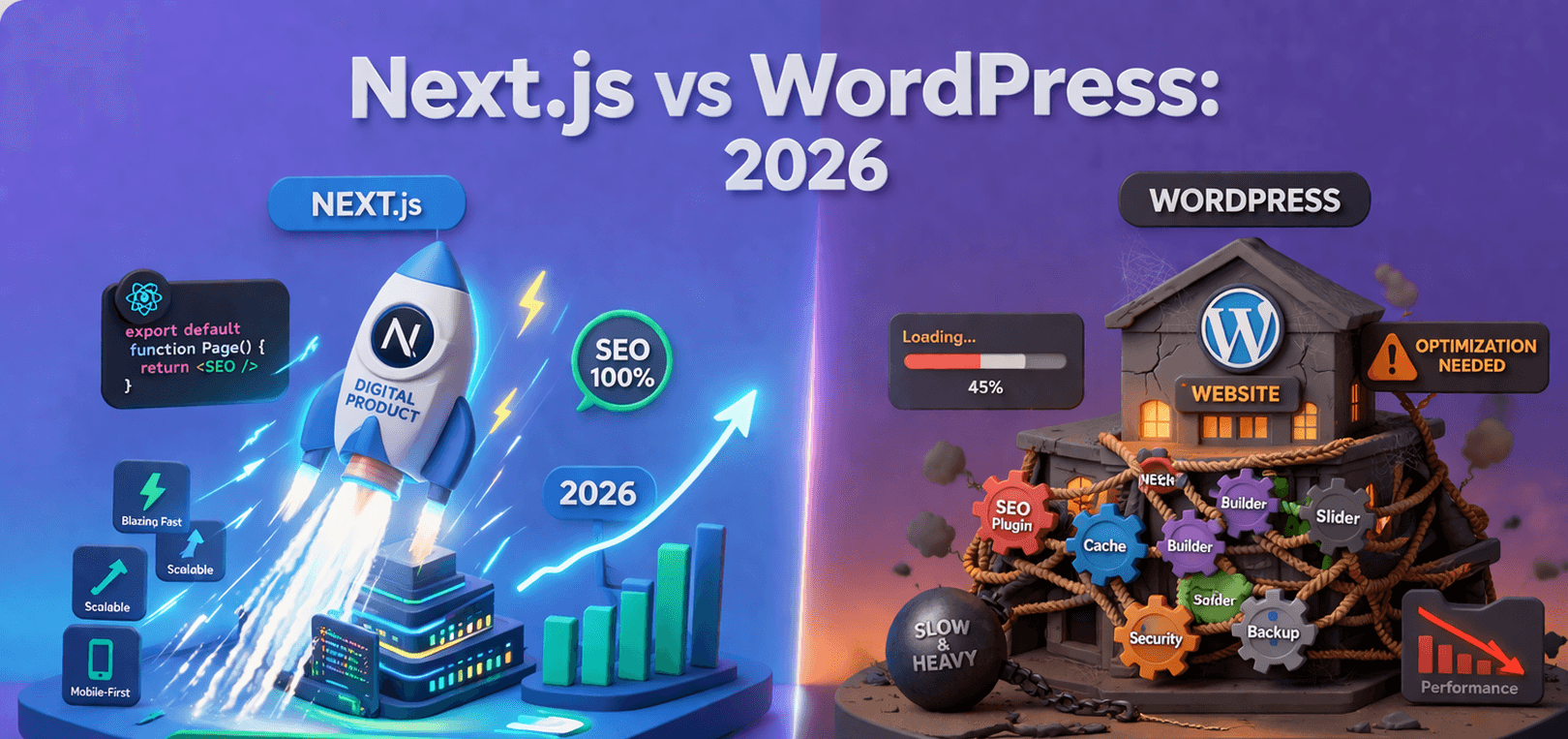
Next.js vs WordPress - Which is Better in 2026?
“Build it with WordPress, it’s cheaper” - this is probably the most common advice businesses hear when they start thinking about creating a website. And to be fair, this advice isn’t entirely wrong. WordPress has become one of the most popular platforms in the world over the years because it is simple, accessible, and quick to launch.
However, this is exactly where the problem begins. What worked 5-10 years ago doesn’t always work today. In the digital reality of 2026, where user attention is lost within seconds and competition is more aggressive than ever, having just any website is no longer enough. A website has become a critical business tool that directly impacts sales, brand perception, and user experience.
This is where the real question arises:
Do you stick with the traditional approach, or move toward modern technology?
WordPress vs Next.js - Two Different Philosophies
WordPress and Next.js are not just technologies - they represent two completely different approaches to building websites.
WordPress is designed to make website creation as simple as possible. Its biggest strength is its ecosystem - thousands of themes and plugins that allow you to build a functional website in just a few days. This makes it especially attractive for small businesses with limited budgets or no technical team.
Next.js, on the other hand, takes a completely different path. It is a modern framework that allows developers to build fast, scalable, and fully customized web applications. There are no rigid templates - you create exactly what your business needs.
In simple terms:
WordPress gives you “a website,”
Next.js gives you “a digital product.”
Speed - The Detail That Changes Everything
User behavior has changed dramatically. If a website takes more than 3 seconds to load, there’s a high chance the visitor will leave immediately. This means lost traffic, lost leads, and ultimately lost revenue.
One of the main challenges with WordPress appears here. Its reliance on plugins often leads to performance issues over time. The more features you add, the heavier and slower the website becomes. In many cases, additional optimization, caching, and technical intervention are required just to maintain acceptable speed.
With Next.js, the situation is completely different. It uses modern architecture such as Server-Side Rendering and Static Generation, meaning pages are pre-built and delivered almost instantly. Combined with CDN infrastructure, this ensures fast loading times regardless of the user’s location.
The result is simple:
A faster website = better user experience = higher conversions.
SEO - No Longer Just About Content
Many businesses believe SEO is all about keywords and well-written content. In reality, technical SEO is often even more important.
In WordPress, SEO is typically managed through plugins like Yoast or Rank Math. While powerful, they still add extra layers to the system and can impact performance. If your website is slow or technically flawed, even great content won’t be enough to rank well.
With Next.js, SEO is built into the architecture itself. Fast loading speeds, clean code, proper structure, and modern standards all contribute to better search engine performance. Google heavily prioritizes Core Web Vitals, and this is where Next.js has a significant advantage.
Security - Invisible but Critical
Security is often overlooked until something goes wrong.
As the most popular CMS in the world, WordPress is also the most common target for hackers. The vast ecosystem of plugins and themes increases the likelihood of vulnerabilities. If a website is not regularly updated or relies on unreliable plugins, the risk grows significantly.
Next.js, especially when using static sites, minimizes these risks. There is no direct database exposure, which reduces the chances of attacks like SQL injection or XSS. For businesses that take their digital infrastructure seriously, this difference is crucial.
Content Management - Simplicity vs Flexibility
This is where WordPress still holds a strong advantage. Its admin panel is intuitive and easy to use. Even users with minimal experience can manage content, publish articles, or update pages without difficulty.
In contrast, Next.js typically relies on headless CMS solutions such as Payload, Sanity, or Strapi. While this may seem more complex at first, it provides significantly more flexibility. You are no longer limited by a single system - you can structure and manage content exactly the way your project requires.
Pricing - Short-Term Savings vs Long-Term Investment
One of the biggest arguments in favor of WordPress is its low initial cost. You can choose a ready-made theme, install a few plugins, and launch quickly.
However, the long-term reality is often different. As your business grows, new requirements emerge - better performance, improved security, custom functionality. This leads to additional costs, ongoing optimization, and in many cases, a complete rebuild.
Next.js may require a higher initial investment, but it is an investment in a system that scales with your business. You build a strong foundation that does not need constant fixes or restructuring.
Scalability - When Your Business Grows
A key factor for any business is whether the website can grow alongside it.
WordPress websites often require stronger hosting and additional resources as traffic increases. This results in higher costs and more technical complexity.
With Next.js, especially when using static pages distributed via CDN, performance remains consistent regardless of traffic size. Whether you have 100 visitors or 1,000,000, the experience remains fast and stable.
Final Decision - What’s Right for You?
If your goal is to quickly launch a simple website on a limited budget, WordPress is still a solid choice.
However, if you care about:
· Speed
· SEO performance
· Security
· Long-term scalability
Then Next.js clearly stands out as the better solution.
Conclusion
Today, a website is no longer just about “being online.” It is one of the most important tools for your business.
Choosing between WordPress and Next.js is ultimately a choice between two approaches:
Do you want a quick and simple solution for today, or a strong and scalable foundation for the future?
If your goal is quality, speed, and growth - the answer becomes clear:
The future is Next.js.
Not sure which technology fits your business?
Our Services
👉 Book an appointment