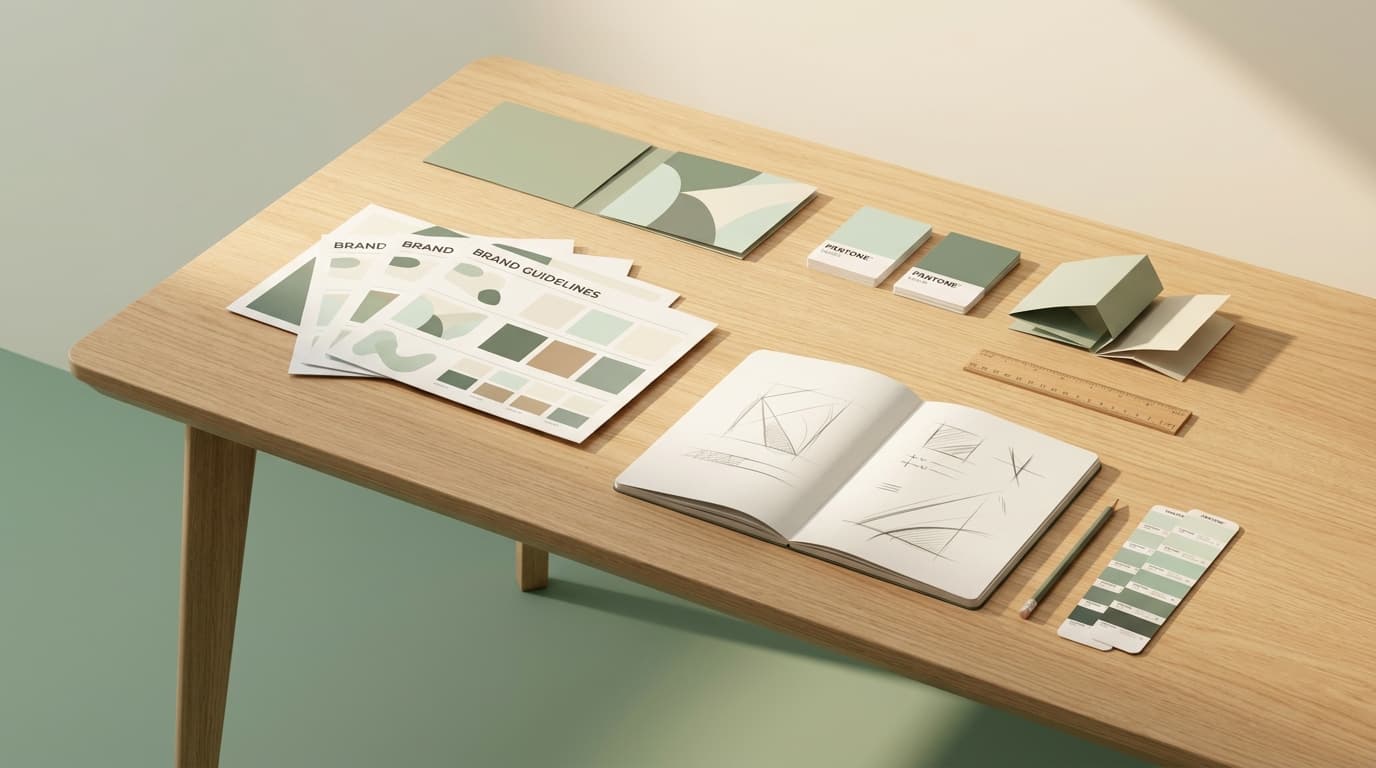
When starting a business, one of the very first decisions involves your visual appearance. Entrepreneurs often oversimplify this phase: "I just need a nice graphic to put on my Facebook profile and slap onto a shop sign." That is precisely where confusion around pricing begins. Hiring a freelancer for logo design might cost a negligible sum, while an agency charges a completely different rate for a full visual identity. Why is there such a massive gap, and what are you actually paying for?
A logo is never just a simple illustration. It is the primary mark of recognition for your company, shaping the very first impression in your customer's memory.
What Is the Difference Between a Logo and Brand Identity?
To put it simply, a logo is the face of a brand, while brand identity is its entire body, personality, tone of voice, and choice of clothes. When potential buyers come across your company, they do not look at a single icon in isolation. They notice colors, read typography, observe social media layouts, and inspect packaging quality. If these parts do not align, the business instantly looks untrustworthy. You can read more about this in our guide on creating a brand identity.
Picture this scenario: a company boasts a modern logo, but hands out business cards printed on cheap paper, runs a website with completely unrelated colors, and posts on social channels using three different random fonts. This kind of visual chaos triggers subconscious doubt in potential clients.
What Does Professional Logo Design Include?
A professional approach never starts in Illustrator. It begins with business analysis, competitor research, and defining target customer personas. When a design agency delivers final deliverables, the client never receives just a single image file. A comprehensive process includes several key elements:
- Logo variations for different environments - Primary horizontal logo (for website headers), stacked or vertical layouts (for signs and print banners), and a simplified mark or monogram (for social profile pictures and website favicons).
- Color system (Color Palette) - Primary and secondary color codes established for digital screens (RGB, HEX) as well as print production (CMYK, Pantone). This ensures your signature blue or forest green looks identical on a phone screen and on physical brochures.
- Typography and fonts - Selected font pairings for headlines and body text, with complete Georgian and Latin character support.
- Production-ready source files - Scalable vector assets (AI, SVG, PDF) that can scale up to a building wrap without losing sharpness, alongside transparent PNGs for everyday company use.
Core rule: A professionally crafted logo must look just as sharp on a giant roadside billboard as it does as a 16-pixel icon on a phone screen.
What Is a Brandbook and Why Does a Business Need One?
A brandbook (or Brand Guidelines) is the official rulebook for your brand. It is an operational document defining how to apply your visual system and, equally important, how not to apply it.
Whenever a new marketing hire joins your team, an external print shop produces packaging, or an advertising partner creates a campaign, they never have to guess safe margins or font weights. You hand over your brand guidelines, where every detail is clearly spelled out:
- Safe zones around the logo and minimum reproduction sizes
- Approved color combinations and background contrast standards
- Clear examples of unacceptable usage (stretching, unapproved colors, improper placement)
- Corporate collateral layouts (business cards, letterheads, email signatures, staff uniforms)
- Social media design templates
Working on the Aurumstone project showed us firsthand how decisive clear visuals are. When a company supplies premium architectural stone, every touchpoint from the logo to the website color scheme needs to communicate durability and refinement. That is why throughout our projects, every visual solution is engineered specifically around the unique character of the business and its audience.
Just a Logo vs. a Complete System: A Comparison
To make your decision easier, let us examine what a business gets when purchasing an isolated logo compared to an end-to-end identity system:
|
Feature |
Standalone Graphic Logo |
Complete Identity and Brandbook |
|---|---|---|
|
Usability |
Only one or two locked sizes |
Fully adapted for all digital and physical formats |
|
Print Quality |
Colors shift and lines blur on print |
Exact CMYK/Pantone color values for print shops |
|
Time Saved |
Re-explaining style rules to every new hire |
A single manual ready for any contractor or agency |
|
Market Perception |
Amateurish and temporary |
Established, reliable, and premium appearance |
|
Legal Security |
Risks using stock vectors or templates |
Full custom work with complete commercial rights |
How Does a Solid Visual Identity Build Customer Trust?
Consumers form opinions within fractions of a second. When visitors arrive at your social page or website for the first time, they have not experienced your product or service yet. Their initial judgment relies entirely on your visual polish. For a deeper breakdown of how people assess digital credibility, check out our article on how customers evaluate business credibility.
Consistency creates an immediate sense of reliability. When a business presents cohesive colors, an organized logo, and uniform collateral, buyers subconsciously conclude: "This company has its operations in order, so their services will likely be top-tier as well." That trust directly fuels sales and enables your company to command premium market rates.
Frequently Asked Questions
What file formats should I receive from a designer?
A professional delivery package must include vector files (AI, SVG, EPS, or PDF) along with high-resolution raster files (PNG and JPG). Vector files ensure your logo never loses crispness, no matter how large it is scaled.
How long does it take to develop a logo and visual identity?
Developing a tailored logo alongside core visual guidelines typically takes anywhere from a few business days to two weeks. This time window is essential to run research, draft creative concepts, and polish technical details.
Can an existing logo be refreshed through a redesign?
Yes. Many established businesses do not need a radical reinvention, but rather a cleaner, modern redesign. This approach preserves existing brand recognition while removing clutter and ensuring readability across modern digital devices.
Summary
When a company invests in a logo and brandbook, it is not paying for an artistic illustration. It is investing in an operational visual system designed to work reliably for years. Professional logo design saves hours of back-and-forth, prevents expensive print mishaps, and turns casual browsers into confident buyers.
If you want your brand to leave a lasting, professional mark from the first glance, book a free consultation with our team and let us build a visual identity that drives real business results.